Chart & guide
Personality Colors: What Each Color Means
Personality colors are a simple way to describe four temperaments: Orange stands for action and freedom, Gold for responsibility and order, Green for logic and knowledge, and Blue for empathy and meaning. Everyone has some of all four, and your brightest color shows what you value most and what wears you out fastest.
Wondering what your favorite color says about you instead? That’s a different idea, and we explain the difference below.
The four-color system comes from the True Colors model, which Don Lowry created in 1978 to make David Keirsey’s temperament theory easy to use in classrooms and workplaces. This site is independent and isn’t affiliated with True Colors International. Our free test uses the same four color names, so if you took a True Colors personality test at school or work, the color meanings below will look familiar. The descriptions are our own.
The color is a name, not a mood. Being Blue has nothing to do with feeling blue, and a Green doesn’t have to like green. Each of the four color personality types is shorthand for a set of values and habits that tend to show up together.
The four personality colors at a glance
Start in the middle of the wheel and read outward. Each quarter shows one color’s core value, what it needs, and what wears it down. If you remember one ring, make it the second: freedom, responsibility, competence, authenticity.
What each personality color means
Each card covers the color’s core value, a motto, what it looks like on an ordinary day, what drains it, and what you’ll hear people with that color say. For careers, relationships and growth, follow the link to the full profile.
The Doer · Core value: Freedom
What Orange means
“Do it now. Make it fun.”
Orange means action. Orange people trust what they can see, touch and try right now, and they want the freedom to do it their own way.
On an ordinary day
An Orange friend texts “Who’s up for tacos?” at six and has a table by six-thirty. At work they grab the live demo, the angry customer or the fix that has to ship before lunch. They learn a new gadget by pressing buttons, not by reading the manual.
What drains an Orange
- Long meetings that end without a decision
- Step-by-step rules for things they already know how to do
- Waiting on approvals
- The same routine, day after day
You’ll hear an Orange say
- “Let’s just try it.”
- “What’s the fastest way?”
- “I’ll figure it out as I go.”
The Organizer · Core value: Responsibility
What Gold means
“Do it right, on time.”
Gold means responsibility. Gold people keep their word, plan ahead and feel settled when everyone knows what’s expected of them.
On an ordinary day
A Gold coworker sends the agenda the day before and keeps the shared calendar color-coded. At home they know when the car registration expires and where the spare key lives. Gold people show love through favors they never forget, like an airport pickup at exactly the time they promised. To a Gold, being punctual is a form of respect.
What drains a Gold
- Last-minute changes to a settled plan
- People who don’t follow through
- Vague instructions and fuzzy roles
- Messy handoffs and missed deadlines
You’ll hear a Gold say
- “What’s the plan?”
- “I said I would, so I will.”
- “Let’s do it right the first time.”
The Thinker · Core value: Competence
What Green means
“Show me why.”
Green means understanding. Green people want to know how things work, and they respect logic and skill more than titles or tradition.
On an ordinary day
A Green will happily spend a Saturday working out why the Wi-Fi drops every evening, then explain the fix whether or not you asked. In meetings they ask the question that makes the room go quiet: “What problem are we actually solving?” They’d rather work alone on something hard than in a group on something easy.
What drains a Green
- “Because that’s how we’ve always done it”
- Being micromanaged
- Explaining the same thing over and over
- Pressure to agree before they’ve thought it through
You’ll hear a Green say
- “Why does it work that way?”
- “What’s the evidence?”
- “There’s probably a better way.”
The Connector · Core value: Authenticity
What Blue means
“Be real. Be kind.”
Blue means connection. Blue people want honest relationships and a sense that their work and their life add up to something.
On an ordinary day
A Blue writes a real message in the birthday card instead of just signing it. In a group project they make sure the quiet person gets heard, and in a family they’re often the one everyone calls to talk things through. A big salary with a cold team won’t hold them for long.
What drains a Blue
- Tension that nobody will talk about
- Cold or sarcastic feedback
- Feeling used or taken for granted
- Being asked to act against their values
You’ll hear a Blue say
- “How are you really doing?”
- “Is everyone okay with this?”
- “I want this to mean something.”
Personality color chart
Here are the personality color traits side by side. Read across a row to compare the colors, or down a column to see one color whole. The table below the infographic repeats it as text and adds blind spots, how each color recharges, and the matching Keirsey temperament.
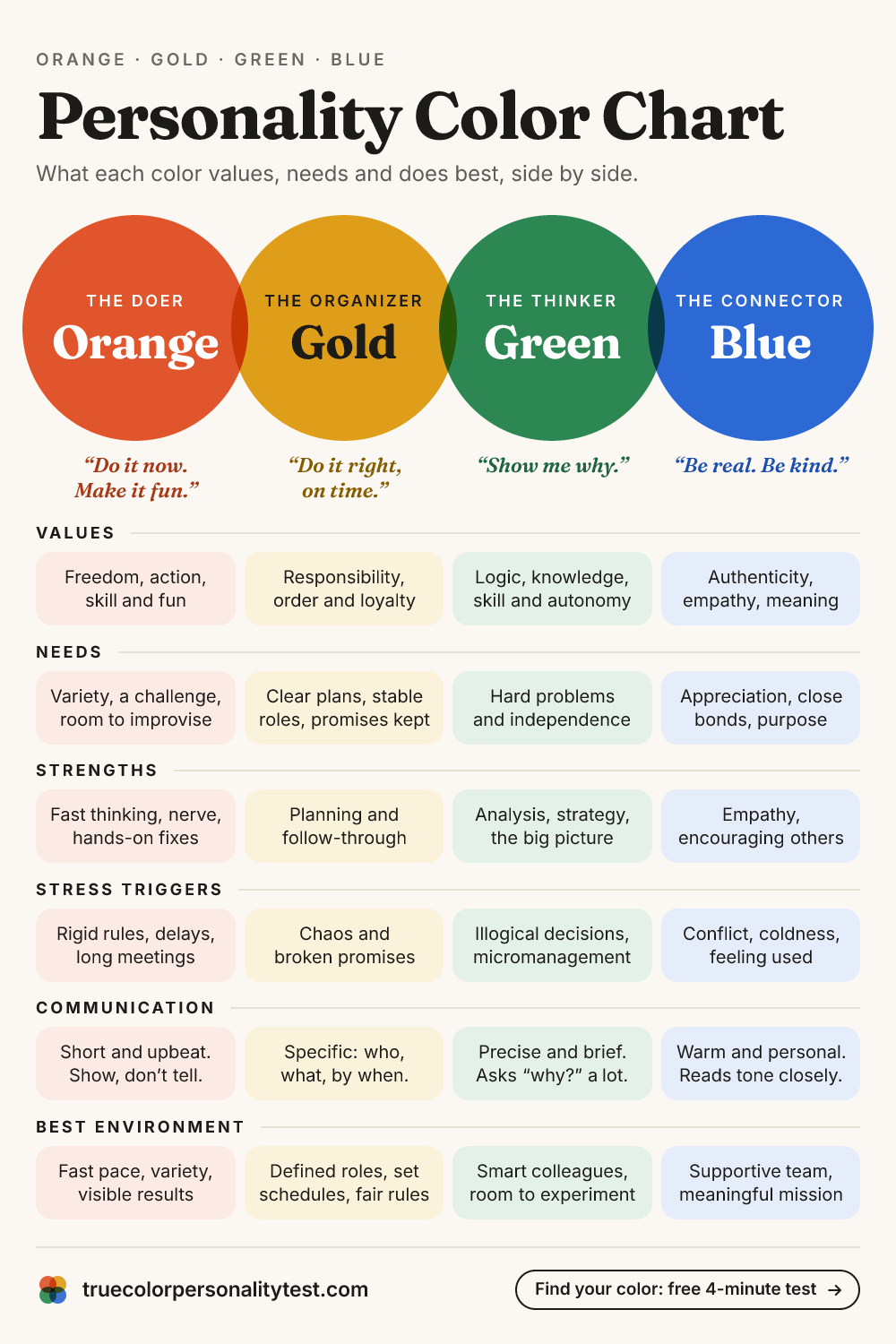
Save the personality color chart
A printable, shareable version of the chart (PNG, 1000 × 1500). Free to use in a classroom or workshop with a link back to this page.
The personality color chart as a table
Scroll sideways to see all four colors.
| Trait | OrangeThe Doer | GoldThe Organizer | GreenThe Thinker | BlueThe Connector |
|---|---|---|---|---|
| Core value | Freedom | Responsibility | Competence | Authenticity |
| Motto | “Do it now. Make it fun.” | “Do it right, on time.” | “Show me why.” | “Be real. Be kind.” |
| Values | Freedom, action, skill and fun | Responsibility, order, loyalty, tradition | Logic, knowledge, skill and autonomy | Authenticity, harmony, empathy, meaning |
| Needs | Variety, a challenge, room to improvise | Clear plans, stable roles, promises kept | Hard problems, time to think, independence | Close relationships, appreciation, purpose |
| Strengths | Fast thinking, nerve, hands-on fixes | Planning, reliability, steady follow-through | Analysis, strategy, seeing the big picture | Empathy, encouraging others, building trust |
| Stress triggers | Rigid rules, delays, long meetings | Chaos, late changes, broken promises | Illogical decisions, micromanagement | Conflict, coldness, feeling unappreciated |
| Communication | Short and upbeat. Show, don’t tell. | Clear and specific: who, what, by when. | Precise and brief. Asks “why?” a lot. | Warm and personal. Reads tone closely. |
| Best environment | Fast pace, variety, visible results | Defined roles, set schedules, fair rules | Freedom to experiment with smart colleagues | Supportive team with a meaningful mission |
| Common blind spot | Skipping the dull follow-up work | Resisting a change that would help | Sounding cold or dismissive | Avoiding a conflict that needs to happen |
| Recharges by | Moving, playing, trying something new | Finishing the list in a tidy space | Time alone with an interesting problem | A long talk with someone close |
| Keirsey temperament | Artisan | Guardian | Rational | Idealist |
Read the stress row with someone else in mind. Most friction between colors is one person’s normal habit landing on the other person’s trigger. A Gold’s careful plan can feel like a cage to an Orange, and an Orange’s “let’s wing it” can feel like a broken promise to a Gold. Our color compatibility guides cover every pairing, including Orange and Gold and Green and Blue.
What your second color means
Almost nobody is one color. A four-color test ranks all four, and the color in second place changes how your first color shows up. A useful rule of thumb is that your first color is what you care about most, and your second color is how you tend to go after it.
Take two Blues. A Blue-Gold cares about people and proves it by being dependable, the friend who sets up the meal sign-up sheet after a surgery and takes the first night. A Blue-Orange cares just as much but shows it with energy, turning a rough week into a last-minute road trip. Same core value, different tools.
It works the same way for every color. A Green-Gold studies a problem and then builds a careful plan, while a Green-Orange is already testing a theory before the plan exists. A Gold-Green turns a messy process into a checklist that works, and a Gold-Blue becomes the person a neighborhood or office leans on.
Order matters too. A Gold-Blue starts from duty and adds warmth, while a Blue-Gold starts from warmth and adds structure.
All 12 personality color blends
Orange first
Why colors? The idea behind the names
Sorting people into four temperaments is an old idea that goes back to the four humors of ancient Greek medicine. In the twentieth century, psychologist David Keirsey gave it a modern form with four temperaments he called Artisan, Guardian, Rational and Idealist. Don Lowry swapped those labels for colors, and the appeal is easy to see. “I’m a Gold” is easier to remember, and easier to say in a staff meeting, than “I’m a Guardian.”
The colors themselves don’t carry the meaning. Nothing about orange paint makes a person spontaneous, which is why other systems use the same colors for different things. In Taylor Hartman’s Color Code, Blues are motivated by close relationships and hold high standards. In Insights Discovery, “Cool Blue” is the precise, analytical style, closer to Green on this site.
So check which model a result came from before you compare it with a friend’s. Our guide to color personality models lines the main systems up side by side. For background, read what True Colors is and where it came from and Keirsey’s four temperaments, the theory underneath it.
What about red, yellow, green and blue?
Many workplace tests use a different set of four colors: red, yellow, green and blue. These come from the DISC family of behavior-style tools and from Insights Discovery, and they describe how you act in a group rather than what you value. As a rough guide, red is direct and results-driven, yellow is sociable and upbeat, green is patient and supportive, and blue is careful and analytical.
Notice that green and blue nearly trade places. A “green” in those tools sounds a lot like a Blue on this site, and their “blue” sounds like our Green. The models measure different things, so the match is only approximate. If you took a red-yellow-green-blue test at work, the side-by-side comparison shows how the systems line up.
Personality colors vs. favorite-color psychology
If you searched “color personality” hoping to learn what your favorite color says about you, you’ve landed on a related but different idea. The two get mixed up all the time, so here’s how they differ.
What favorite-color psychology claims
Pop-psychology lists match colors to traits. Love red and you’re supposedly bold and passionate. Love blue and you’re calm and loyal. It’s fun and can start a good conversation, but the evidence that a favorite color reveals stable personality traits is weak. Color preferences shift with culture, fashion and personal history. White is the traditional wedding color in the US, while in parts of East Asia it has long been tied to mourning.
Research on why people like certain colors points to experience. In a 2010 study, Stephen Palmer and Karen Schloss found that people tend to like colors linked to things they enjoy, such as clear skies and clean water, and to dislike colors linked to things like rotting food. That says more about your life so far than about your temperament.
The Lüscher color test
The best-known formal version is the Lüscher color test, developed by Swiss psychotherapist Max Lüscher in the mid-twentieth century. You rank colored cards from most to least liked, and the order is read as a sign of your current emotional state. It’s a projective test, which means it interprets your reaction to something open-ended. Research hasn’t shown that it measures personality reliably, so treat online versions as entertainment.
What temperament colors claim
Temperament colors work the other way around. You never pick a color. You answer questions about what you do and what you value, and the test counts which of four patterns your answers match most often. The color is only the label printed on the result. A Gold can love wearing orange, and a Green can paint the bedroom blue, without any effect on the score.
None of this makes temperament tests scientific instruments. They’re self-report tools built for reflection and conversation, and the research behind them is thinner than for models like the Big Five. Our honest look at whether True Colors is accurate covers what they can and can’t tell you.
How to read your personality color result
A four-color result is a ranking, not a verdict. Here’s what each part of it tells you, using a made-up example in the same format as our test.
Example result · illustration
Blue-Gold
- Blue38%
Brightest color. Your default setting: what you value most and notice first.
- Gold29%
Second color. Shapes how the first one shows up. Together they make a Blue-Gold blend.
- Green21%
Supporting color. A style you can switch on when a situation calls for it.
- Orange12%
Faintest color. Often the style that tires you most, or puzzles you most in other people.
Your brightest color
The color with the highest score is the one you reach for when nobody is telling you how to act. It describes what you value and what you notice first in a room. It doesn’t limit you, though. Plenty of Blues run tight budgets, and plenty of Golds tell great jokes.
Your spectrum
On our test the percentages show how often your answers matched each color, not how much of a trait you have, so 38% Blue isn’t “more caring” than 30% Blue. Read all four together. Your faintest color deserves attention too, because it often points to the people and situations you find most draining.
Blends and close scores
If your top two colors are within a point or two of each other, you’re a true blend. Our test asks a tiebreak question when the top scores tie exactly, but a near-tie still means both colors matter. Someone who scored Gold-Blue by one point should read Blue-Gold too.
Change over time
Your order can shift as your life does. A job full of deadlines can pull Gold answers up for a while, and a new sport might bring Orange forward. Many people find their brightest color stays fairly steady while the lower ones move around. If a result feels off, retake the test on a calm day and answer for how you usually are. For how much weight to give any of this, read our look at how accurate four-color tests are.
Personality colors FAQ
What are the four personality colors?
The four personality colors are Orange, Gold, Green and Blue. Orange stands for freedom and action, Gold for responsibility and order, Green for knowledge and competence, and Blue for empathy and honest relationships. The system comes from the True Colors model Don Lowry created in 1978, which put David Keirsey’s four temperaments into everyday language. Everyone has all four colors in some mix.
What does my personality color mean?
Your top color describes what you value most and how you act when you’re comfortable. Orange means you’re driven by action and freedom, Gold by duty and order, Green by understanding and skill, and Blue by connection and meaning. Your second color shows how you tend to go after those things, so read your two-color blend as well as your top color.
Is my personality color the same as my favorite color?
No. On a four-color temperament test you never choose a color. You answer questions about your habits and values, and the color is simply the name of the pattern that fits you best. Favorite-color psychology works the other way around, reading meaning into the color you like. A Blue personality can love orange, and it won’t change the result.
What does my second color mean?
Your second color shapes how your first color shows up. A Green-Gold and a Green-Orange both want to understand how things work, but the Green-Gold builds a careful plan while the Green-Orange starts testing ideas right away. Order matters too, so Gold-Green and Green-Gold describe different people. Each of the 12 combinations has its own profile on this site.
Which personality color is the best?
None of them. Each color brings strengths a group needs, and each has blind spots. A team with all four has an Orange to get things moving, a Gold to keep them on track, a Green to question the plan and a Blue to keep people working together. The most useful color in a room is often the one that’s missing.
Can your personality color change?
Your scores can shift, especially the lower ones. Life stage, job demands and stress all affect how you answer, so a year of tight deadlines might pull Gold forward for a while. Many people find their top color stays fairly steady. If a result surprises you, retake the test on a calm day and answer for how you usually behave, not how this week has been.
Do personality colors mean the same thing in every test?
No. The four colors on this site follow the True Colors tradition, but other models assign colors differently. The Color Code uses Red, Blue, White and Yellow, and its Blue centers on relationships and high standards. In Insights Discovery, Cool Blue is the precise, analytical style, closer to Green here. Check which model a result came from before you compare two of them.
Are personality colors scientifically accurate?
Four-color tests are useful for self-reflection and team conversations, but they aren’t validated clinical or hiring tools. They rest on temperament theory, and the research behind them is thinner than for the Big Five personality traits. Treat your color as a starting point for noticing patterns in yourself and other people, not as a fixed label or a diagnosis.
What’s your personality color?
Take the free 4-minute test to see your brightest color, your full spectrum and your two-color blend.
Take the free test